Single driveway slab
$300 – $800
One settled section or corner

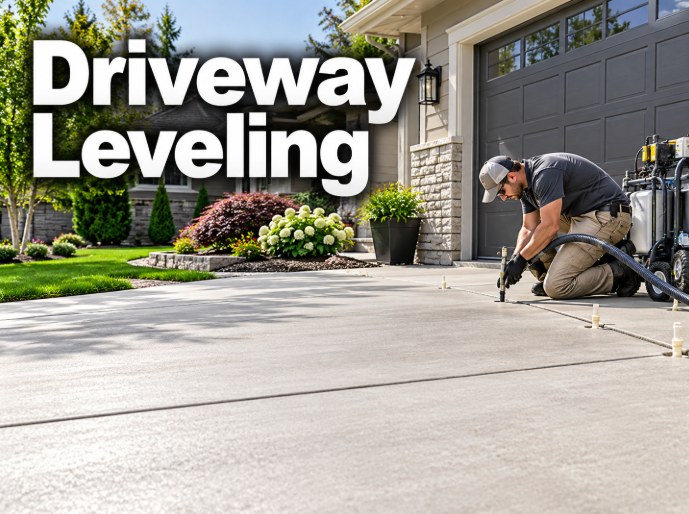
Lift sunken slabs, smooth the garage entrance and remove trip hazards without tearing out your driveway.
A driveway should provide a smooth, stable path from the street to your garage or parking area. Over time, however, sections of concrete can settle, tilt, or become uneven as the soil underneath changes. Driveway leveling is designed to correct these problems without automatically replacing every slab.
Uneven driveway concrete is more than a cosmetic issue. A sunken section can create a noticeable bump when a vehicle enters the garage, allow rainwater to collect near the house, and produce raised edges that are uncomfortable to walk across. When the concrete itself remains structurally usable, leveling can often restore a more even surface while preserving the existing driveway.
Concrete driveway slabs rely on the soil beneath them for support. When that support changes, the concrete can move.
Common causes include:
A driveway may settle evenly across a large section or only in one corner. Correcting the problem begins with evaluating how each slab has moved and identifying where support has been lost.
Driveway leveling is used to reposition concrete slabs that have dropped below their intended elevation. Depending on the condition of the driveway and the leveling system being used, material can be introduced beneath a slab to fill unsupported spaces and carefully raise the concrete.
The goal is controlled correction rather than simply forcing a slab upward.
Technicians evaluate adjacent slabs, the garage floor, sidewalks, drainage areas, expansion joints, and surrounding landscaping before determining the appropriate finished height.
One of the most common signs of driveway settlement is a raised edge between two neighboring slabs.
Even a relatively small difference in elevation can create a trip point for homeowners, visitors, delivery drivers, and anyone walking across the driveway at night.
Leveling the lower slab can reduce the height difference while maintaining a more natural transition between sections.
Settlement where the driveway meets the garage is particularly noticeable.
When the exterior slab drops, vehicles may encounter a sharp lip when entering the garage. Water can also collect along the transition instead of moving away properly.
Driveway leveling can help improve this transition by raising the settled exterior concrete closer to the elevation of the garage floor.
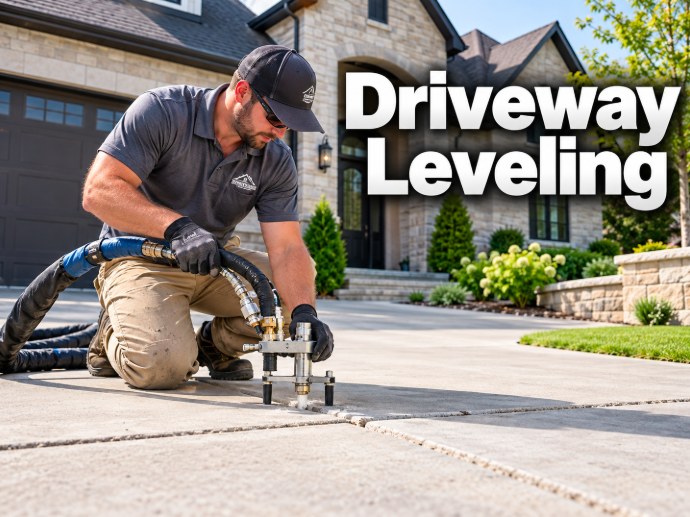
Sunken driveway sections can form depressions where rainwater remains after surrounding surfaces have dried.
Although leveling cannot correct every drainage problem, changing the elevation of settled slabs may improve surface water movement when settlement is contributing to the issue.
Drainage patterns should always be considered before lifting concrete because the objective is not simply to create a flat driveway. The finished surface should also direct water appropriately.
Leveling addresses movement and elevation. It does not make existing cracks disappear.
Some cracks may become less visually pronounced after slabs are repositioned, while others may remain and require separate repair.
Before work begins, the condition of the concrete should be evaluated to determine whether a slab is strong enough to lift. Severely deteriorated concrete may be a better candidate for replacement.
Replacement removes existing concrete and installs a completely new surface. That approach is appropriate when slabs are extensively broken, crumbling, improperly reinforced, or damaged beyond practical repair.
Leveling takes a different approach.
Instead of discarding usable concrete, it attempts to restore the position of existing slabs. This can reduce demolition and minimize disruption around garages, landscaping, gates, and neighboring concrete.
Concrete settlement can affect driveways of many sizes, including:
Every layout requires a slightly different leveling plan because slab dimensions, drainage direction, access, and surrounding surfaces vary.
Consider having your driveway evaluated if you notice:
Early correction may help prevent movement from becoming more severe.
Driveway leveling can be an effective option when settlement has changed the position of otherwise serviceable concrete.
By evaluating slab condition, underlying support, drainage, and surrounding elevations, a leveling plan can be developed to improve the driveway while keeping as much of the original concrete as practical.
From the first visit to the final cleanup, here's how we handle driveway leveling for Santa Clarita properties.
We measure each slab, check the garage transition and look for voids, cracks and drainage problems.
You get a clear plan showing which slabs will be lifted, the target heights and the price.
Small, evenly spaced ports are drilled in the settled slabs so material can reach the empty spaces beneath.
Material is injected in stages while we monitor height so the slab rises evenly and drains correctly.
Ports are patched, joints are sealed where needed and the work area is cleaned before we leave.
Driveway leveling is priced by the number of slabs that need lifting and how far they have dropped. Most Santa Clarita homeowners pay far less than replacing the driveway.
$300 – $800
One settled section or corner
$600 – $2,400
Common for garage-apron and center-seam settlement
$300 – $800
Raising the exterior slab closer to the garage floor
Custom Quote
Priced after measuring every affected slab
Prices are typical ranges for Santa Clarita projects. Your exact price is confirmed in writing after a free on-site inspection.
Answers to the questions Santa Clarita property owners ask us most about driveway leveling.
Ask Us a QuestionIn most cases you can walk on the driveway right away and park on it the same day. Because no new concrete is poured, there is no multi-day curing period. We'll confirm the exact wait time for your project before we pack up, based on the material and the slabs we lifted.
Yes, this is one of the most common driveway problems we correct. When the exterior slab drops, we raise it back toward the garage floor elevation so vehicles roll in smoothly. We also check that the finished slope still moves water away from the garage door instead of toward it.
Leveling corrects elevation and support, not cracks. Some cracks look less noticeable once the slabs line up again, while others remain visible. If you want them addressed, cracks can be filled or sealed separately after the driveway has been lifted to its corrected position.
For driveways where the concrete is still solid, leveling usually costs a fraction of tear-out and replacement. It also avoids demolition, dumpster fees and damage to landscaping. If your slabs are crumbling or broken into many pieces, we'll tell you honestly that replacement is the better investment.
Yes. We level side-yard parking pads, RV pads, driveway extensions and attached walkways as part of the same visit. Each area is evaluated on its own, because slab size, thickness and drainage can differ from the main driveway.
Send us a few details and we'll schedule a free inspection at your Santa Clarita property, then give you a written price before any work begins.
(661) 554-9972